Case study · Collector edition · Chassis ending 3303
The right car. The wrong number.
A buyer wanted this 911 GT3. Wanted it properly. And still refused to buy it on wanting alone: it had to hold up as a car to drive and as an asset to keep. Those are two different questions, and only one of them was ever about the car.
01 · The car
The last one Porsche
built this way.
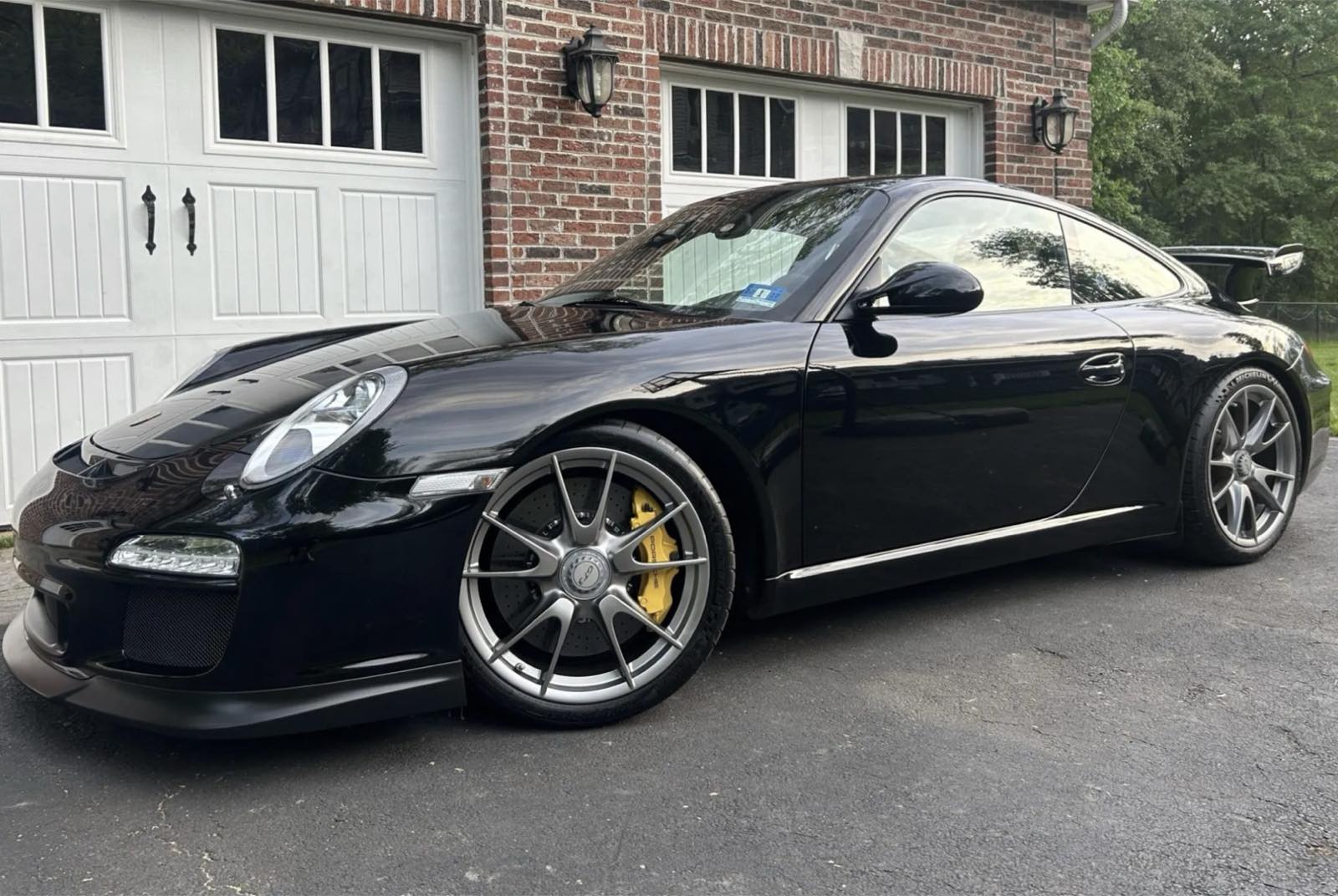
The 997.2 GT3 is the end of a line, and everyone in the room knows it. It is the last standard GT3 to carry the Mezger flat-six, a dry-sump racing architecture wound to 8,400 rpm, sold with hydraulic steering and a six-speed manual and nothing in between the driver and the crankshaft. What replaced it was quicker, and was not the same thing. There will not be another.
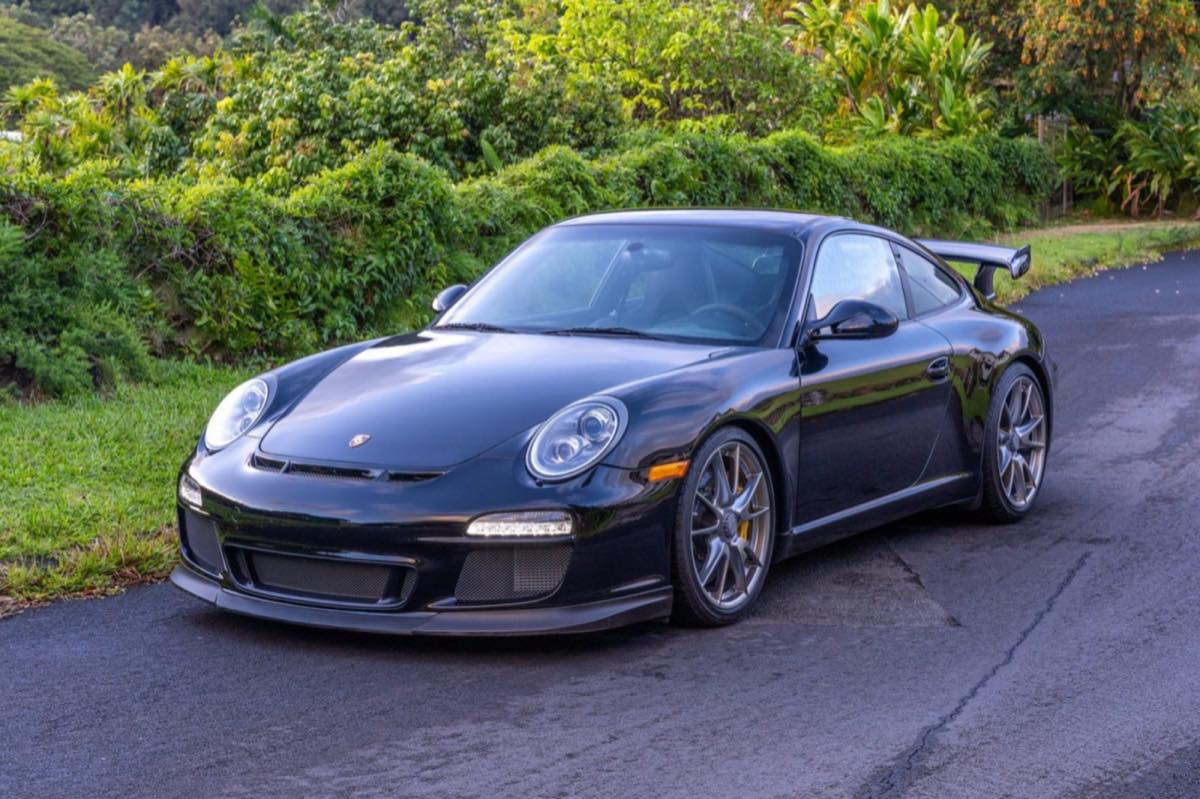
This particular one is Black over black leather and Alcantara, 16,762 miles across fifteen years and five owners, factory carbon-ceramic brakes and the factory lightweight-wheel option, no accidents, no airbags, factory colour at every title event in its life. Its first seven years and twelve thousand miles were serviced exclusively at the authorized Porsche dealer that delivered it new. That is the spine of the file, and it is a good one.
It came to market on Bring a Trailer in May 2026 as a public auction, which means the whole thing happened in daylight: the listing, the disclosures, the comment thread, the bids. Somewhere in the middle of that, a buyer commissioned a dossier.
The chassis, as filed
| Model | 997.2 GT3, US-spec |
|---|---|
| Engine | Mezger 3.8 M97.77 |
| Gearbox | 6-speed manual |
| Odometer | 16,762 mi |
| Colour | Black over black |
| Brakes | Factory PCCB |
| Owners | 5 in 15 years |
| Accidents on file | None |
| Channel | Public auction |
Every line here is taken from the title and history file supplied with the commission, or from the listing as it ran.
02 · The brief
Two tests. Only one
was about the car.
Most people who commission a dossier have already fallen for the car. That is not a problem to be talked out of, and we do not try. What a buyer in that position actually needs is the discipline they cannot supply themselves: a number arrived at by somebody with no stake in whether they buy it.
Test one
Does it work as a car?
Is this the right example, honestly represented, mechanically sound, with a record that closes? A GT3 with a hole in its story is a different car from a GT3 without one, whatever they look like parked next to each other.
The file’s job: find every gap, price each one, and name the document that closes it.
Test two
Does it work as an asset?
The buyer intended to drive it and intended to keep it, and wanted the keeping to be defensible. Not a speculation. Just a car that would not quietly cost thirty thousand dollars to have owned.
The file’s job: price the entry against real sales, then show what three years of this cohort has actually looked like.
Both tests come out of the same research run. The engine does not get smaller for anyone: the same evidence swarm, the same comp ledger, the same appraisal arithmetic that a bank or a dealer would get. What changes for a collector is where it aims. Originality and documentation get pressed hardest, the forward band gets built and shown rather than buried, and the writing ends with what to do next week rather than what to put in a credit file.
03 · The comps
Where this cohort
actually trades.
This is where the case is actually made. Not in anything hidden, not in anything clever. In three years of other people’s completed transactions, read against one car.
The 997.2 GT3 is not a thin market, but it is a small one, and almost all of its public price discovery happens in one place. The file captured thirty-four comparable transactions, twenty-two of them direct auction sales of the same model over roughly three years, plus twelve dealer transactions and ten active asks for context. That is the whole evidentiary base for what this car is worth, and it is not ambiguous.
Examples matched to this car’s specification, on the same carbon-ceramic brakes, have cleared between $175,997 and $217,500 across four verified sales. The anchor, the closest match in the world to this car, is a Black 2010 on the same brakes and the same wheel option with seven thousand fewer miles, sold for $180,000. Time-adjusted forward at the cohort’s own appreciation, it expands to roughly $195,000 to $205,000 for a mid-2026 sale.
Now hold that against the bidding. Across three years of records, three examples of this model traded at or above $225,000. Two of them had under three thousand miles: effectively unused cars, sold and priced as such. The third was a paint-to-sample car in Riviera Blue, and a colour like that is its own market with its own buyers. Nothing in the file shows a driven, factory-colour example clearing that money. The highest a used one has ever reached is $217,500, and that car had 7,000 miles. This one has 16,762.
The failures say the same thing as the sales. At the top of the band, cars stop selling. In November 2024 a Carrara White example was listed at $185,000 and drew no bids at all. In September 2025 one with six thousand fewer miles than the subject was bid to $211,500 across five hundred bids and still did not clear its seller’s reserve. Meanwhile the dealer channel asks $209,000 to $339,995 for cars in this cohort, and the file’s reading of that is blunt: those asks sit forty to a hundred and twenty thousand dollars above what anybody actually pays. Reserves going unmet at the top of a band is not a market testing its ceiling. It is sellers pricing above the room.
The bull case is real, and the file grants it in full. This cohort appreciated 13.5 percent year over year through 2025 as the last-Mezger argument found its audience, while the generation that replaced it fell about $40,000 over the same period. The floor is moving. That is a good argument for owning one of these. It is not an argument for paying $225,000 for this one, today, on this record.
The anchor
Black 2010 · same brakes · 10,000 mi
$180,000
Top of the band, driven cars
Basalt Black 2010 · same brakes · 7,000 mi
$217,500
Where the bidding went
This car · 16,762 mi · 207 bids · no sale
$225,000
Every verified sale in the file
Three years of this cohort, and where the bidding on this car got to.
The subject’s own cohort: every standard, unmodified 997.2 GT3 in the file with a published auction result, plus the two reserve-not-met results that bracket the top of the band. The wider comp ledger also carries modified examples, RS references and the dealer channel; those inform the adjustments and are not this cohort. The gold band is the dossier’s published fair-value range. Hover or tap any mark to see the car, and open it for that lot’s own published record. Every result is listed underneath as well, and every one of them goes somewhere you can check.
The Mezger premium is real. The floor is moving. The current bid is already past the homework.
From the dossier, May 2026
04 · The open questions
Four things the file
could not close.
None of what follows is why $225,000 was the wrong number. The comparable sales do that on their own. But a buyer still has to know what they are not being told, and on this car there were four of them.
Three were mechanical and ordinary for a fifteen-year-old car that has sat. Carbon-ceramic rotors have a finite life and nobody had measured these. This model year carries a known camshaft-actuator bolt defect with no preventive entry anywhere in the service record. And an open safety campaign on the centre-lock wheel hubs covers this chassis’s build window, with no confirmation it was ever closed.
The fourth is the interesting one, and it is the smallest. The listing was unusually forthcoming: paint-protection film, a replaced front spoiler, tyres dated 2020 and past their service life, bumper indentations, a chip in the spoiler, coolant lines not pinned, recent suspension work. All volunteered, in the copy or in the comment thread the moment somebody asked. No scarcity language, no one-of-none claim. By the standards of the trade it was a straight listing.
The history file contained one line the listing did not address. In June 2018, at 13,164 miles, a New York service shop replaced an engine or powertrain computer module. The record says that much and no more. If the unit was the engine control module and it was factory-calibrated and coded to this chassis, the value impact is zero. If it was a non-matching unit, or carries an aftermarket tune, the deduct is $3,000 to $8,000. One phone call settles it. Nobody had made the call, and on a listing that surfaced tyre dates unprompted, that silence is a finding in itself. It requires nobody to have intended anything: records get lost, sellers prioritise, data feeds are incomplete. It requires only that somebody ask, and treat silence after the asking as an answer.
Now the proportions. Take all four at their worst and they come to about $20,000. The distance between the $195,000 the record supports and the $225,000 the room was bidding is $30,000. Answer every one of these questions perfectly, in the buyer’s favour, and the defensible ceiling rises to $210,000. The price is still ahead of the evidence. The open questions are worth resolving because they are cheap and because they move the number. They are not what makes the number wrong.
Volunteered by the seller
- Paint-protection film, full front
- Replacement front spoiler
- Chip in the spoiler
- Bumper indentations
- Tyres dated 2020, past service life
- Coolant lines not pinned
- 2025 front-suspension replacement
- Partial service records
In the record, not in the listing
- Engine or powertrain computer module replaced, June 2018, 13,164 miles $0 to −$8,000, depending entirely on which module
Eight disclosures on one side. One line on the other. Worth asking about. Worth up to $8,000. Not worth $30,000.
05 · The number
From one real sale
to a defensible bid.
The arithmetic starts at the anchor and never leaves the record. Time-adjust the closest verified sale in the world to a mid-2026 transaction and it opens at $195,000 to $205,000. Add what this car genuinely has that the market pays for: the carbon-ceramic brakes, the lightweight wheels, and seven unbroken years of authorized-dealer service under its first two owners.
Then subtract, honestly, for everything that has not been proved. Ceramic rotors have a finite life and nobody has measured these. A car driven four hundred and fifty miles a year needs tyres, fluid, a battery and a service before it is fit to use. A known camshaft-actuator bolt defect on this exact model year has no preventive entry anywhere in the service record. And the module line sits there, unresolved, worth up to eight thousand dollars of deduct on its own.
The result is two published bands rather than one, because the honest answer depends on work the buyer had not done yet. With the three open documents unresolved: $170,000 to $196,000. With all three returning clean: $196,000 to $210,000. The dossier signs a bid of $195,000 and a walk-away line at $242,000.
No premium is applied anywhere in the table below. Credits wait for the document that proves them, which is the same discipline that makes the deducts worth anything.
From anchor to appraisal
| Anchor, time-adjusted to May 2026 | $195,000 – $205,000 |
|---|---|
| Carbon-ceramic brakes, factory option | +$5,000 to +$10,000 |
| Continuous authorized-dealer service, 2010–2017 | +$2,000 to +$5,000 |
| Lightweight wheel option, factory | +$1,000 to +$3,000 |
| Ceramic rotor life, unmeasured | −$3,000 to −$10,000 |
| Recommissioning after static storage | −$4,500 to −$9,500 |
| Camshaft-bolt preventive, no record | −$1,000 to −$2,000 |
| Front spoiler and film over paint | −$0 to −$5,000 |
| Module replacement, scope unknown | −$0 to −$8,000 |
| Matching numbers unverified | −$0 to −$3,000 |
| Published, three documents open | $170,000 – $196,000 |
| Published, all three clean | $196,000 – $210,000 |
Every premium and every deduct in this table is conditional on evidence in the file, and each one names the document that would settle it.
The ladder, and where the bidding got to
Drawn to scale. The bidding did not run past the walk-away line, and the dossier never said it had. It ran past the homework: thirty thousand dollars above the number the file could defend, on a car with three documents outstanding and a phone call’s worth of work left undone.
06 · The asset question
Three years out,
on the cohort’s own record.
This is the part most valuations skip, and the part the buyer actually asked for. Owning a car for three years is a position, whether or not anyone calls it one. So the dossier fits the cohort’s own sold results to a trend and projects the band forward, with the uncertainty drawn in rather than hidden.
The model is honest about what it is: nine qualifying sales over 2.3 years with fifteen percent dispersion, which the pipeline itself grades low confidence. It compounds at about three percent a year. It is not a forecast to bet a house on. It is the shape of the thing, and the shape is enough to answer the question that was asked.
Pay $225,000 today and the model’s median outcome three years out is $221,729. Not a loss you would notice in a bad year. Simply nothing: three years of ownership, and the middle case has you back where you started, before tyres, before fluids, before the ceramic rotors nobody has measured.
Pay the $195,000 the file signs and the same median lands at $221,729 with roughly $27,000 of headroom under it. Same car. Same three years. The entire difference is the entry.
Forward value, three years
997.2 GT3 standard cohort · 9 sales · low confidence
Weighted log-linear fit on the cohort’s own sold results, with the forward band widening as the horizon extends. Percentiles restated from the dossier’s projection file.
Buy at $225,000
−$3,271
Median outcome after three years, before recommissioning, tyres and any deferred ceramic-rotor bill.
Buy at $195,000
+$26,729
Same car, same three years, same median. The difference is entirely what was paid on day one.
07 · The homework
Four things to do
before bidding.
A verdict that only says no is not worth commissioning. The whole point of pricing the unknowns separately is that unknowns can be closed, and each one that closes moves the number in a direction the buyer can predict before they spend anything.
Three of the four items below cost under a hundred dollars and a few phone calls. The fourth is a proper specialist inspection, which on a car with carbon-ceramic brakes and a known camshaft-bolt defect is not optional at any price. Together they carry every conditional deduct in the ledger: resolve them clean and the defensible ceiling moves from $196,000 to $210,000. Which is still fifteen thousand dollars short of where the bidding went, and that is exactly why they are worth doing: you find out what the car is worth before you decide what you are willing to lose on it.
They were drafted into the dossier as ready-to-send requests, with the questions written out and the order to ask them in. The buyer had them the same day the file arrived, while the auction was still running.
- The delivering dealer’s records. Seven years and 12,692 miles of exclusive authorized service sit behind one phone call. They also settle a disputed 2017 work order and would show any preventive camshaft-bolt work. Cost: $0 to $75. Blocks close.
- The 2018 module work order. Which module, what part number, was it coded to this chassis. One call to the shop that did it. Cost: $0 to $50. Blocks close, and worth up to $8,000.
- A specialist pre-purchase inspection. Ceramic rotor thickness at all four corners, a factory diagnostic pass for camshaft deviation and engine-module identity, and a paint meter under the film. Cost: $1,000 to $2,000. Blocks close.
- The recall lookup. This chassis falls inside the manufacturing window for an open safety campaign on the centre-lock wheel hubs. The remedy is free; the check takes a minute and a VIN. Cost: nothing. Nobody should close without it.
08 · Where it landed
The verdict was Fair Value, and provisional. Not because the car is bad. Because the car is good, and the price being bid for it had run past the part nobody had finished checking.
Bid to $195,000 · ceiling $210,000 with the documents in hand · walk away above $242,000
Then the auction ended and the market voted. Two hundred and seven bids ran the car to $225,000, and the reserve still was not met. No sale. The seller’s number and the room’s number were not the same number, exactly as the file had said, and the file had said it while the auction was still open.
The buyer did not chase it. They still liked the car as much as they had on the first morning. What they had by then was the ability to say so out loud without it costing them thirty thousand dollars.
Wanting the car was never the problem. Paying for the wanting would have been.
09 · Method
Real numbers,
first sources.
Nothing on this page leans on a third-party price guide or a borrowed valuation feed. Every figure traces to a primary record: the auction platform’s own published results, the listing as it ran, the title and history file supplied with the commission. Each source in the dossier carries its URL and the date we read it, and the citation gate in our pipeline rejects any claim that cannot show one.
The forward band is the cohort’s own sold results and nothing else, published with its confidence grade attached rather than dressed up as certainty. Where the file did not know something, it says so, prices the not knowing, and names what would close it. That is the whole method, and on this car it was worth thirty thousand dollars and a phone call.
The selling dealer is deliberately unidentified and no assertion of intent is made or implied; omissions of this kind are commonly records-handling artifacts. The auction platform is named because its results are public and checkable, which is the point of citing them.
Love the car.
Price it anyway.
This dossier ships as the public sample report, open in your browser with every citation live. Read it before you decide anything.